

Bridgestone World Solar Challenge 2027
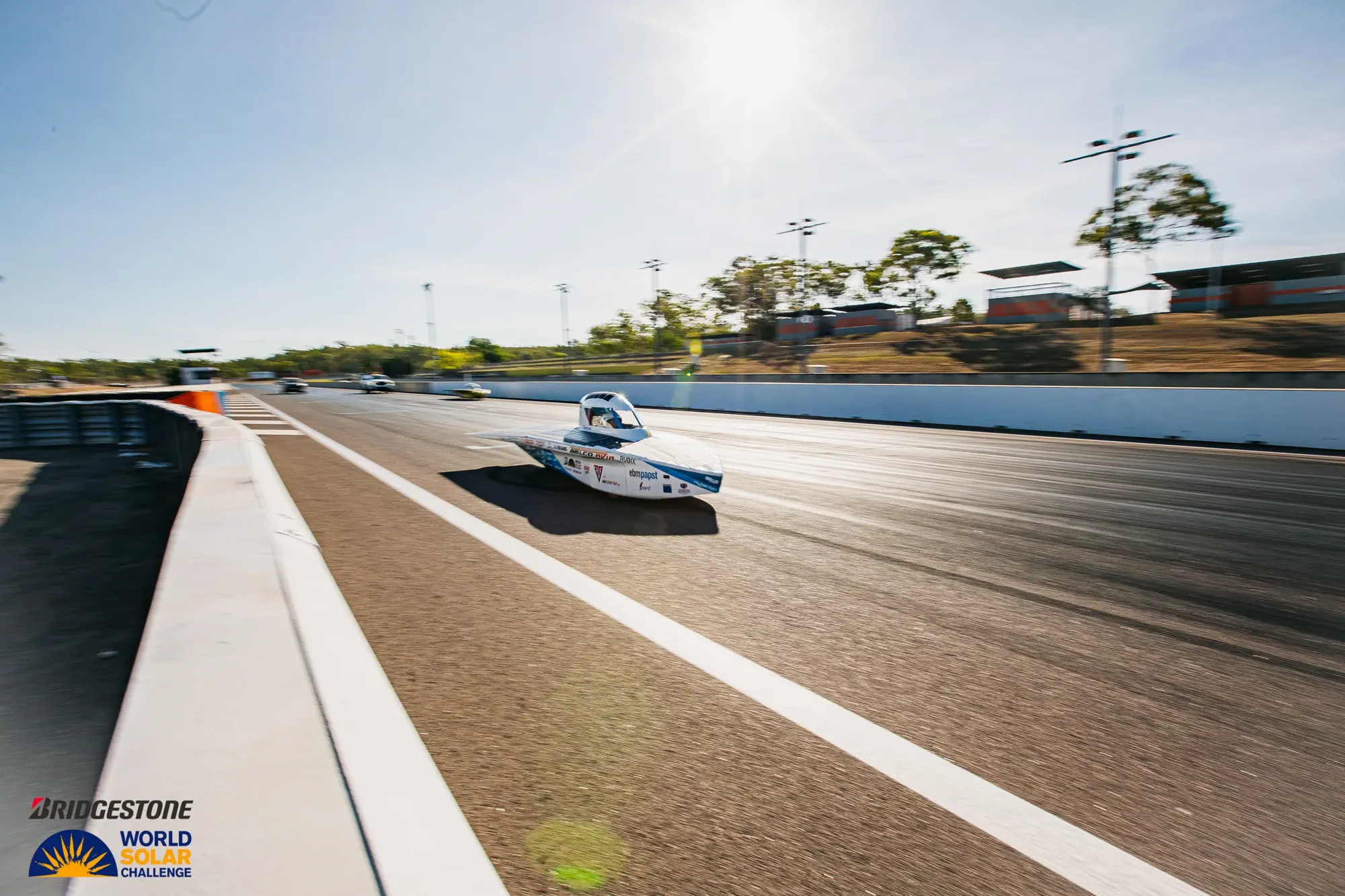
We are going back to Australia with a new vehicle. The 19th edition of the race marks 40 years since the first, in 1987.
days to the start in Darwin
- Event HQ opens in Darwin
- Static scrutineering starts
- Dynamic scrutineering
- Official start in Darwin
- The finish line opens in Adelaide
- Award ceremony
What we are preparing.
For 2027 we are building a new vehicle from scratch, using everything we learnt with Hyperion. We are not showing any of it yet: its shape stays secret until the launch.
The 2027 rules keep the Challenger class with the same limits of 6 m² of solar panels and about 3 kWh of battery. As well as Challenger and Cruiser, the anniversary edition has a Historic class for vehicles from past editions and an Innovation class.
How the race works.
About 3,000 km on public roads, from Darwin in the north to Adelaide in the south. The vehicles set off every morning at 08:00 and stop at 17:00 wherever they are, and the team camps by the road. There are compulsory control stops along the way.
Challenger class
Single-seat vehicles built for speed and efficiency. The first to Adelaide wins. The solar array is at most 6 m² and the battery at most 11 MJ, about 3 kWh.
Cruiser class
Vehicles with two or more seats, also judged on how practical they are. The battery may hold up to 55 MJ.
Control stops
At every control stop the vehicle waits for 30 minutes. Nobody in the team may touch it until the last five minutes, and repairs are not allowed, not even a strip of tape.
Charging
Once the race starts, the only source of energy is the sun. In the morning, the evening and at control stops, the panel is tilted towards it to charge the battery.
Along the route
- Darwin
- Katherine
- Daly Waters
- Tennant Creek
- Alice Springs
- Coober Pedy
- Port Augusta
- Adelaide